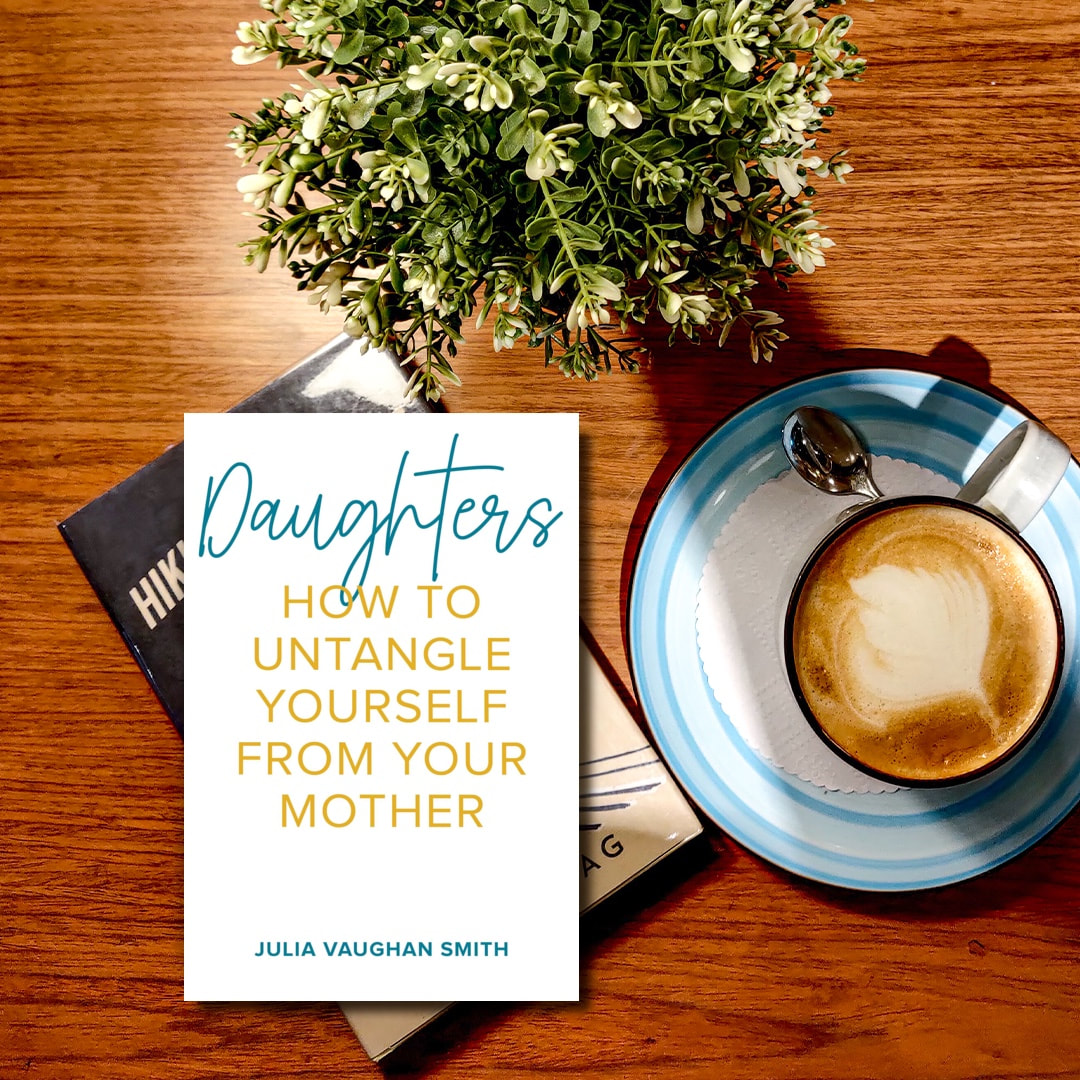
 I first wrote about this in October 2020 after I had completed my research and planning for Daughters: How to Untangle Yourself from Your Mother. What struck me at the time was the guilt some daughters feel talking about their mothers’ failures in mothering; they often qualified what they said with something that excuses the mothers’ behaviour. More recently, this ‘commandment’, Thou Shalt Not Betray Thy Mother, appeared again, this time within me. As I get near to publishing the book I can be overtaken by anxiety that I am betraying my mother for even suggesting that our relationship was difficult at times for me. One of my motivations for writing the book was to give voice to all the daughters who have suffered to a greater or lesser degree from the way their mother related to them, from conception onwards. Many things affect how mothers relate to their daughters, including their own psychology and childhood experience, the circumstances at the time of pregnancy and afterwards, the support around them, life circumstances, as well as the behaviour of the infant and how well that could be tolerated. A number of daughters have suffered greatly from abusive, neglectful, critical or narcissistic mothers, and have largely kept silent outside, perhaps of a therapy room. Some mothers weren’t able to protect their daughters from physical or sexual abuse, and some refused to believe stories of sexual abuse so daughters kept quiet out of fear of not being believed – and in some cases to protect their mother and the family. It's not that there is nothing to say. It’s that the commandment endorsed by society keeps daughters silent. Within this I think there are a at least four reasons some of which I referred to in the blog of October 2020:-
Throughout this book I have been determined not to blame mothers; and indeed, see blaming as part of the unhealthy entanglement. Mothers are daughters, with their own childhood history and stresses in adult life. There are few places where mothers can talk about any negative mothering experiences for fear of being shamed. Some act out of their stress and emotional trauma in their behaviour towards their children. The response of our neuro-physiology in responding to a sense of danger doesn’t concern itself with the motivation of the mother’s action. Many mothers have a motivation to ‘be a good mother’, I doubt any set out to fail their daughters (or sons). However, if through their own psychological development they are unable to feel a strong loving connection with their child their behaviour may at time have been rejecting, hurtful and frightening. A pattern of leaving an infant hungry for too long, or crying alone for too long, produces a fear response in the infant and a lack of trust in the carer. Each generation has its own ‘mothering/parenting guru’ or instructions/expectations. Mothers who want to be good mothers, and who don’t trust themselves to do that naturally, may take on those instructions even where they may not really be in the best interests of the child. In my childhood, it was 4 hour feeding, whether the infant was hungry or not, and no matter how much the infant might have been crying due to hunger. Fashions have changed but the challenge for mothers continues. Is it possible to bring understanding and compassion for mothers and be able to talk of our own experience without feeling we are betraying them? I’d like to encourage us to try. It may be in how we talk about the relationship, and the extent to which we are owning our own part of it as an adult. There may also be some things that we should be mindful of sharing widely out of respect rather than because we feel we mustn’t. We may need to examine the narratives we use more deeply as it is easy to get into a story pattern which leaves out some elements. At the same time, we need to feel able to talk about our own experience and the impact on us, without feeling we are betraying another. Protecting those that hurt us makes sense when we are children, as we have nowhere else to go, but as adults we can come to this with a different mindset. Julia Vaughan Smith March 2023
0 Comments
Your comment will be posted after it is approved.
Leave a Reply. |
Julia's BlogArchives
May 2023
Categories
All
Access Octomono Masonry Settings
|
 RSS Feed